
On Prayer
St Makarios of Egypt
From the Philokalia, p. 828 available at :https://www.wisdomlib.org/christianity/book/nicene-and-post-nicene-fathers/d/doc1580169.html
Unless humility and love, simplicity and goodness regulate our prayer, this prayer - or, rather, this pretense of prayer - cannot profit us at all. And this applies not only to prayer, but to every labor and hardship undertaken for the sake of virtue, whether this be virginity, fasting, vigil, psalmody, service or any other work. If we do not see in ourselves the fruits of love, peace, joy, simplicity, humility, gentleness, guilelessness, faith, forbearance and kindliness, then we endure our hardship to no purpose. We accept the hardships in order to reap the fruits. If the fruits of love are not in us, our labor is useless. In such a case we differ in nothing from the five foolish virgins: because their hearts were not filled here and now, in this present life, with spiritual oil - that is to say, with the energy of the Spirit active in the virtues of which we have spoken - they were called fools and were abjectly excluded from the royal bridechamber, not enjoying any reward for their efforts to preserve their virginity (cf. Matt. 25:1-13). When we cultivate a vineyard, the whole of our attention and labor is given in the expectation of the vintage; if there is no vintage, all our work is to no purpose. Similarly, if through the activity of the Spirit we do not perceive within ourselves the fruits of love, peace, joy and the other qualities mentioned by St Paul (cf. Gal. 5:22), and cannot affirm this with all assurance and spiritual awareness, then our labor for the sake of virginity, prayer, psalmody, fasting and vigil is useless. For, as we said, our labors and hardships of soul and body should be undertaken in expectation of the spiritual harvest; and where the virtues are concerned, the harvest consists of spiritual enjoyment and incorruptible pleasure secretly made active by the Spirit in faithful and humble hearts. Thus the labors and hardships must be regarded as labors and hardships and the fruits as fruits. Should someone through lack of spiritual knowledge think that his work and hardship are fruits of the Spirit, he should realize that he is deluding himself, and in this way depriving himself of the truly great fruits of the Spirit.
The person who has surrendered himself entirely to sin indulges with enjoyment and pleasure in unnatural and shameful passions - licentiousness, unchastity, greed, hatred, guile and other forms of vice - as though they were natural. The genuine and perfected Christian, on the other hand, with great enjoyment and spiritual pleasure participates effortlessly and without impediment in all the virtues and all the supranatural fruits of the Spirit - love, peace, patient endurance, faith, humility and the entire truly golden galaxy of virtue - as though they were natural. He does not fight any longer against the passions of evil, for he has been totally set free of them by the Lord; while from the blessed Spirit he has received Christ’s perfect peace and joy in his heart. Of such a man it may be said that he cleaves to the Lord and has become one spirit with Him (cf. 1 Cor. 6:17).
THEOPHANY
Writings of the Holy Fathers on the Baptism of Jesus Christ
St Cyril of Jerusalem, Catechetical Homily III
Baptism is the end of the Old Testament, and beginning of the New. For its author was John, than whom was none greater among them that are born of women. The end he was of the Prophets: for all the Prophets and the law were until John (Matt 11:13): but of the Gospel history he was the first-fruit. For it saith, The beginning of the Gospel of Jesus Christ, & c.: John came baptizing in the wilderness (Mark 1:1,4). You may mention Elias the Tishbite who was taken up into heaven, yet he is not greater than John: Enoch was translated, but he is not greater than John: Moses was a very great lawgiver, and all the Prophets were admirable, but not greater than John. It is not I that dare to compare Prophets with Prophets: but their Master and ours, the Lord Jesus, declared it: Among them that are born of women there hath not risen a greater than John (Matt 11:11): He saith not “among them that are born of virgins,” but of women. The comparison is between the great servant and his fellow-servants: but the pre-eminence and the grace of the Son is beyond comparison with servants. Seest thou how great a man God chose as the first minister of this grace?—a man possessing nothing, and a lover of the desert, yet no hater of mankind: who ate locusts, and winged his soul for heaven (Isa 40:31): feeding upon honey, and speaking things both sweeter and more salutary than honey: clothed with a garment of camel’s hair, and shewing in himself the pattern of the ascetic life; who also was sanctified by the Holy Spirit while yet he was carried in his mother’s womb. Jeremiah was sanctified, but did not prophesy, in the womb (Jer 1:5): John alone while carried in the womb leaped for joy (Luke 1:44), and though he saw not with the eyes of flesh, knew his Master by the Spirit: for since the grace of Baptism was great, it required greatness in its founder also.
St John of Damascus, Exact Exposition of the Orthodox Faith, Book IV, Chapter IX
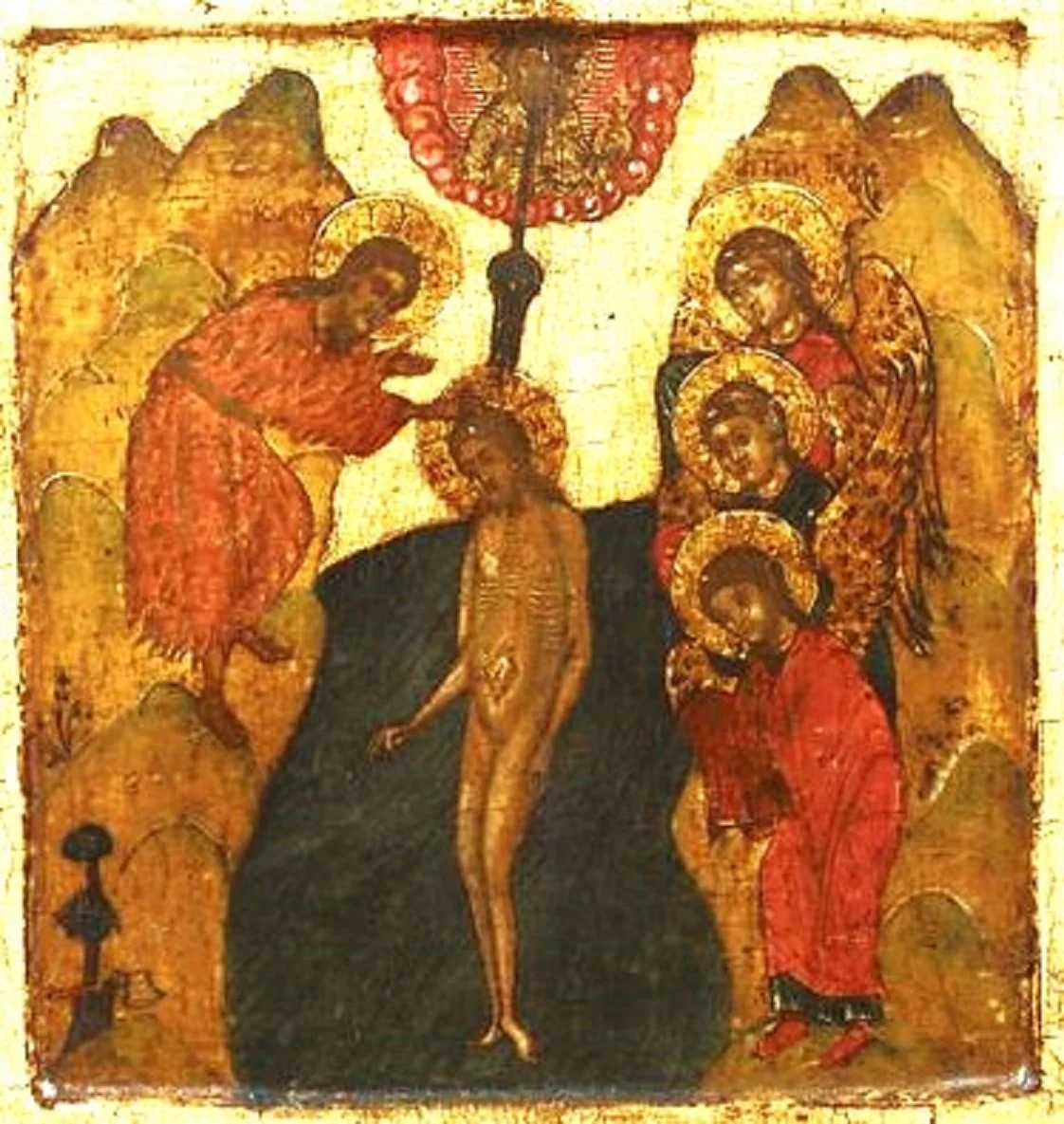
Further, the Holy Spirit descended in bodily form as a dove, indicating the first fruits of our baptism and honoring the body: since even this, that is the body, was God by the deification; and besides the dove was wont formerly to announce the cessation of the flood. But to the holy Apostles He came down in the form of fire (Acts 2:3): for He is God, and God is a consuming fire (Deut 4:24).
Olive oil is employed in baptism as a significant of our anointing, and as making us anointed, and as announcing to us through the Holy Spirit God’s pity: for it was the fruit of the olive that the dove brought to those who were saved from the flood (Gen 8:11).
John was baptized, putting his hand upon the divine head of his Master, and with his own blood.
It does not behoove us to delay baptism when the faith of those coming forward is testified to by their works. For he that cometh forward deceitfully to baptism will receive condemnation rather than benefit.
St Gregory the Theologian, Oration 39, on the Holy Lights, Book IV, Chapter IX
Now, since our Festival is of Baptism, and we must endure a little hardness with Him Who for our sake took form, and was baptized, and was crucified; let us speak about the different kinds of Baptism, that we may come out thence purified. Moses baptized (Lev 11) but it was in water, and before that in the cloud and in the sea (1 Cor 10:2). This was typical as Paul saith; the Sea of the water, and the Cloud of the Spirit; the Manna, of the Bread of Life; the Drink, of the Divine Drink. John also baptized; but this was not like the baptism of the Jews, for it was not only in water, but also “unto repentance.” Still, it was not wholly spiritual, for he does not add “And in the Spirit.” Jesus also baptized, but in the Spirit. This is the perfect Baptism. And how is He not God, if I may digress a little, by whom you too are made God? I know also a Fourth Baptism—that by Martyrdom and blood, which also Christ himself underwent: — and this one is far more august than all the others, inasmuch as it cannot be defiled by after-stains. Yes, and I know of a Fifth also, which is that of tears, and is much more laborious, received by him who washes his bed every night and his couch with tears (Ps 6:6); whose bruises stink through his wickedness (Ps 37:5); and who goes mourning and of a sad countenance; who imitates the repentance of Manasseh (2 Chron 33:12) and the humiliation of the Ninevites (Jonah 3:7-10) upon which God had mercy; who utters the words of the Publican in the Temple, and is justified rather than the stiff-necked Pharisee (Luke 18:13); who like the Canaanite woman bends down and asks for mercy and crumbs, the food of a dog that is very hungry (Matt 15:27).